


Lion’s Mane Mushroom Benefits in India: What the Science Actually Says
Lion’s Mane mushroom is having a moment in India. You’ve probably seen it on Instagram, in nootropic supplement stacks, or mentioned in wellness circles. But what does the science actually say — and what’s just clever marketing?
At Shroom Actives, we believe you deserve straight answers. So here’s an honest breakdown of Lion’s Mane benefits, what’s well-supported, what needs more research, and what to look for if you’re considering a supplement.
What Is Lion’s Mane?
Lion’s Mane (Hericium erinaceus) is an edible medicinal mushroom that has been used in traditional Chinese and Indian medicine for centuries. It gets its name from its distinctive appearance — cascading white tendrils that resemble a lion’s mane.
What makes it scientifically interesting are two unique compounds found in its fruiting body: hericenones and erinacines. These bioactive molecules are the focus of most modern Lion’s Mane research.
What the Science Actually Supports
1. Nerve Growth Factor (NGF) Stimulation
The most well-documented mechanism of Lion’s Mane is its ability to stimulate the production of Nerve Growth Factor (NGF) — a protein essential for the growth, maintenance, and survival of neurons. Hericenones (from the fruiting body) and erinacines (from the mycelium) both appear to cross the blood-brain barrier and support NGF synthesis.
This is significant because NGF declines naturally with age, and reduced NGF is associated with cognitive decline, poor memory, and neurodegeneration. Supporting NGF production is one reason Lion’s Mane is classified as a nootropic.
2. Cognitive Function and Mental Clarity
A 2009 double-blind, placebo-controlled study published in Phytotherapy Research found that adults aged 50–80 who consumed Lion’s Mane for 16 weeks showed significantly improved scores on cognitive function tests compared to the placebo group. Scores declined after supplementation stopped.
A more recent 2020 study on patients with mild Alzheimer’s disease found that 1g of Lion’s Mane daily for 49 weeks significantly improved cognitive test scores. While more large-scale human trials are needed, the early evidence points consistently in the same direction: Lion’s Mane supports brain function, particularly in areas of focus, memory, and mental clarity.
3. Mood and Anxiety
A small but interesting 2010 study found that women who consumed Lion’s Mane cookies for four weeks reported significantly reduced feelings of anxiety and irritability compared to a placebo group. The proposed mechanism is that NGF support in the hippocampus — the brain region involved in memory and emotional regulation — may contribute to improved mood.
This isn’t a replacement for clinical mental health treatment, but for people dealing with everyday stress and brain fog (a very real issue for India’s urban working population), it’s a meaningful area of research.
4. Neuroprotection
Animal studies have shown that Lion’s Mane extracts may help protect against the neuronal damage caused by amyloid-beta plaques — the hallmark of Alzheimer’s disease. While we can’t directly translate animal findings to humans, this neuroprotective potential is one of the more actively researched areas in functional mushroom science.
What Still Needs More Research
To be honest with you: most Lion’s Mane studies are small, short-term, or conducted in animals. The cognitive benefits are promising but not yet proven at the level required for medical claims. You should treat Lion’s Mane as a supportive wellness supplement — not a pharmaceutical.
Claims like “cures dementia” or “guaranteed memory boost” are exaggerated and unsupported. Anyone making those claims is either misinformed or misleading you.
Why It’s Particularly Relevant in India Right Now
India’s cities are running faster than ever. Long working hours, digital overload, academic pressure, and irregular sleep have created a generation of young professionals dealing with chronic mental fatigue. Interest in natural, non-stimulant cognitive support — terms like “nootropic” and “mental clarity supplement” — has grown significantly in Indian search trends, particularly in Mumbai, Bengaluru, Delhi, Pune, and Hyderabad.
Lion’s Mane fits this need well: it’s non-stimulant, plant-based (technically fungi-based), FSSAI-certifiable, and backed by enough research to take seriously. It’s not caffeine — it won’t give you a spike and crash. It works gradually, supporting the brain’s underlying biology over weeks of consistent use.
What to Look for in a Lion’s Mane Supplement in India
Not all Lion’s Mane supplements are equal — and in India, the difference in quality is significant. Here’s what to check:
Fruiting body, not mycelium on grain: The hericenones that stimulate NGF are found in the fruiting body (the actual mushroom). Many budget supplements use mycelium grown on rice or oats and are mostly starch, not active compounds. Always confirm the source.
Declared beta-glucan percentage: Beta-glucans are one of the key bioactive markers of a quality mushroom extract. If a brand doesn’t declare their beta-glucan content, they likely have something to hide.
Third-party lab testing (COA): A Certificate of Analysis from an independent lab confirms potency and safety — heavy metals, microbial contamination, and active compound levels. Reputable brands make this available. Scan the QR code on the batch or ask for it directly.
FSSAI certification: In India, look for FSSAI-registered supplements. It’s the baseline for food safety compliance.
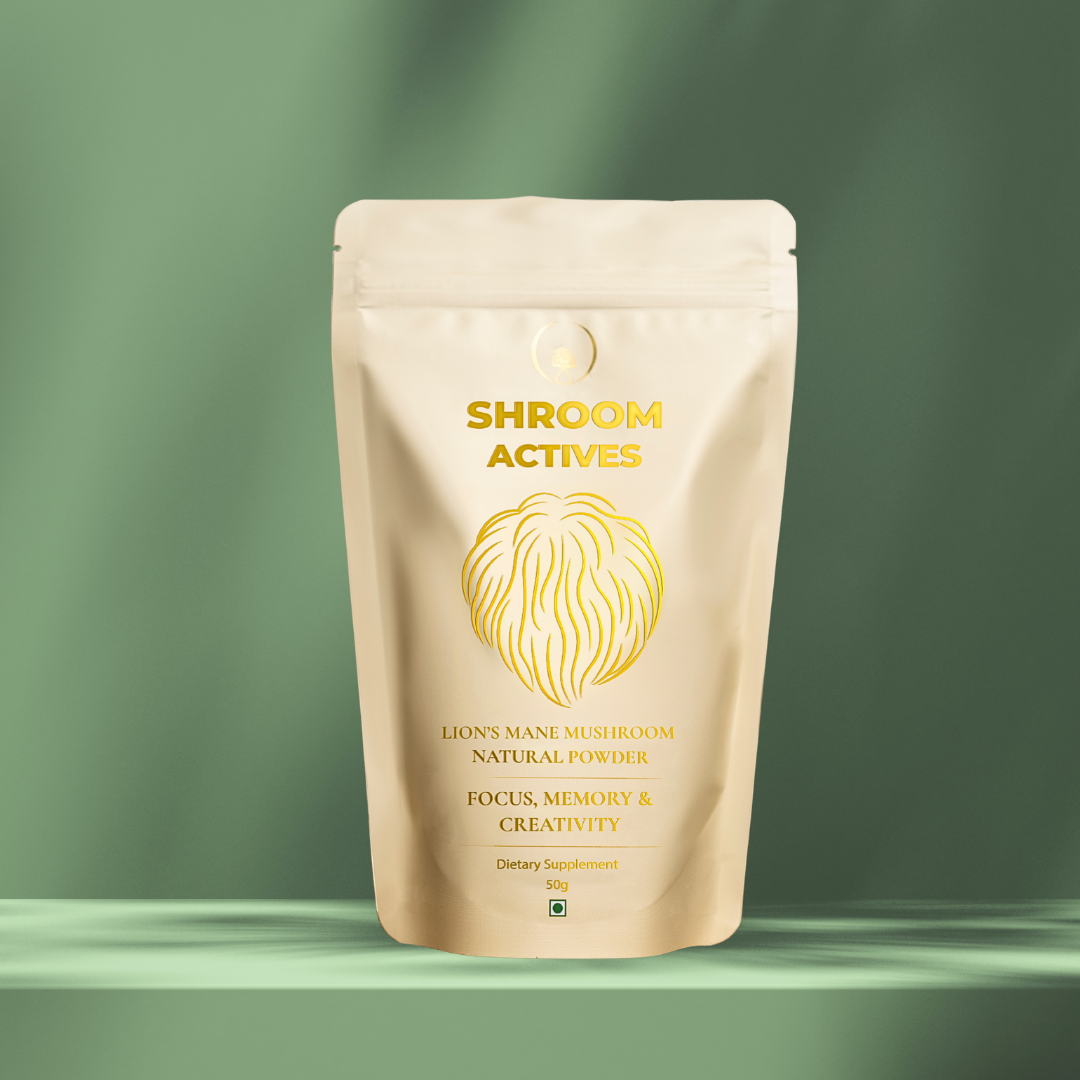
Shroom Actives’ Lion’s Mane Drops tick all of these: 100% fruiting body extraction, declared beta-glucan %, QR-linked batch COAs, and FSSAI certification. We produce with ICAR technology transfer standards and source from Indian cultivation — no imported mycelium on grain.
How Long Does It Take to Work?
Most people report noticing subtle improvements in mental clarity and focus within 3–4 weeks of consistent daily use. Cognitive benefits in clinical studies typically emerged at the 4–8 week mark. Lion’s Mane is not a one-dose fix — it’s a long-game supplement that rewards consistency.
Bottom Line
Lion’s Mane is one of the most scientifically credible functional mushrooms available. The evidence for NGF stimulation, cognitive support, and mood balance is real — and while more human research is needed, what exists is consistently positive.
If you’re looking for a clean, non-stimulant cognitive supplement in India, Lion’s Mane is worth serious consideration. Just make sure you’re getting it from a source that uses actual fruiting body extraction, declares its beta-glucan content, and backs every batch with a lab report.
References: Mori et al. (2009), Phytotherapy Research; Br J Nutr (2020); Kawagishi et al. (1994); Frontiers in Nutrition (2025).
Ready to try the real thing?
Every batch HPLC-verified. Every number on the label, real.